Click Through Rate: The Most Important Metric You're Ignoring

A brilliant video hidden behind terrible packaging simply does not exist on the internet. If you treat your thumbnails and titles as an afterthought, you are actively killing your algorithmic potential. Read about the psychology of the "curiosity gap," the exact visual rules for a high-converting, mobile-first thumbnail, and why mastering your click through rate is the ultimate cheat code for explosive channel growth.
Click Through Rate: The Most Important Metric You're Ignoring
How do you improve your YouTube Click-Through Rate (CTR)? To significantly improve your click through rate, you must treat your video's packaging as a priority, not an afterthought, by following these four steps:
-
Develop a Concept First: Design your thumbnail and title before you even write the video script.
-
Create a Curiosity Gap: Ensure the title and thumbnail do not repeat each other; they must work together to ask a compelling question.
-
Minimize Visual Clutter: Limit thumbnail text to three words or fewer and use high-contrast focal points.
-
A/B Test Relentlessly: Prepare three distinct thumbnail variations before publishing and test them dynamically in the first 24 hours.
It is a uniquely painful heartbreak experienced only by modern content creators. You just spent forty hours meticulously researching a topic, writing a brilliant script, setting up expensive lighting, and grinding through a complex Premiere Pro timeline. You are convinced this is the best piece of content you have ever produced. You render the file, hit publish, and anxiously refresh your YouTube Studio analytics dashboard. The video flatlines at 100 views.
You immediately assume the platform is broken, or that the algorithm is actively punishing your channel. The reality, however, is that the algorithm didn't hate your video; it just never got the chance to watch it!
The audience scrolled past your masterpiece without a second thought because your click through rate was abysmal. You treated the thumbnail and title as an afterthought and slapped them together in five minutes at the end of a grueling production cycle.
A brilliant video hidden behind terrible packaging simply does not exist. Your content's packaging dictates its entire success. If they do not click, the edit does not matter.
This deep dive is a masterclass on the psychology of the click, how the algorithm evaluates your packaging, and why protecting your time to focus on your pre-click strategy is the ultimate cheat code for explosive channel growth.
Gatekeeper Metric: Understanding Click Through Rate
Before you can optimize your packaging, you must fundamentally understand how digital platforms distribute content. Every major content platform (YouTube, TikTok, Instagram) operates as a recommendation engine designed to keep users on the app for as long as possible.
Defining the Metric
Your click-through rate is a simple mathematical equation: the percentage of people who clicked on your video after being shown the thumbnail (an impression). If YouTube shows your thumbnail to 1,000 people on their homepage, and 50 people click it, your CTR is 5%. This metric acts as the absolute, non-negotiable gatekeeper to the algorithm.
The Algorithm's First Test
When you publish a new video, YouTube does not immediately blast it to a million people. Instead, it pushes your thumbnail to a small, highly targeted "seed audience", typically your most loyal subscribers and frequent viewers. This is a test.
If this core audience ignores the video (resulting in a low CTR), the algorithm concludes that the video is uninteresting. It immediately halts distribution, and your video dies in its tracks. Conversely, if your seed audience clicks at an exceptionally high rate, the algorithm registers a positive signal and expands the impressions to a broader, secondary audience.
The Compound Effect of the Click
Creators fundamentally misunderstand the math behind CTR. A 2% increase in your click-through rate does not result in a 2% increase in total views. Because of algorithmic compounding, an increase from a 4% CTR to a 6% CTR can mean the difference between 10,000 views and 500,000 views.
Once your packaging proves it can capture attention in broad, mainstream audiences, the algorithmic recommendation engine acts as a massive multiplier, snowballing your impressions exponentially.
Psychology of a Click (The Curiosity Gap)
Understanding “the math” is only half the battle. To actually get users to click, you must understand human psychology. You are competing against thousands of other thumbnails on a crowded screen; you must give the user an unavoidable reason to stop scrolling.
The Biggest Creator Mistake: Redundancy
The most common mistake creators make is treating the thumbnail and the title as the exact same piece of real estate. If your video is about fixing a leaky sink, you might title it: "How to Fix a Leaky Sink." If your thumbnail text also says "How to Fix a Leaky Sink," you have created massive redundancy.
There is no psychological tension here. Worse, if your thumbnail shows the final, fully repaired sink, you have already given away the ending. There is absolutely no reason for the user to click because they already have the answer.
Opening the Loop
Elite packaging relies on a psychological concept known as the "curiosity gap." The thumbnail and the title must work synergistically to ask an unignorable question, creating a mental itch that the user can only scratch by clicking the video. You must "open a loop" in the viewer's brain.
For example, imagine a personal finance channel doing a video about saving money on groceries.
-
Bad Packaging: Thumbnail says "Save Money on Groceries." Title says "How to Save Money on Groceries." (Boring, redundant).
-
Elite Packaging: Thumbnail shows a person holding a single apple with a massive $50 price tag floating above it, looking shocked. The text says "Wait, what?" The title reads: "The Grocery Industry is Lying to You."
The elite packaging creates a massive curiosity gap. The user must click to find out what the lie is and why the apple costs $50.
Engineering a High-Converting YouTube Thumbnail Strategy
To execute the curiosity gap effectively, your visual design must be flawless. Designing a high-converting youtube thumbnail strategy requires abandoning complex artistic design in favor of mobile-first, high-contrast psychology. Over 70% of YouTube traffic comes from mobile devices, meaning your thumbnail is often the size of a postage stamp.
The "Three Element" Rule
A high-converting thumbnail should never have more than three distinct visual focal points (e.g., a face, an object, and a background). Anything more than three elements creates visual clutter. When a user scrolls rapidly on a mobile phone, a cluttered thumbnail looks like a gray, messy blur. The brain cannot process the information quickly enough, so the thumb keeps scrolling.
Contrast and Saturation
Color theory plays a massive role in thumb-stopping power. Your subject must pop aggressively against the background. If your creator is wearing a dark blue shirt and standing against a dark grey wall, the image will blend into YouTube's dark mode UI.
Elite creators utilize heavy color saturation, bright rim lighting, and complementary color palettes (like placing a warm, orange subject against a cool, teal background) to forcefully draw the eye.
Observe the 3-Word Text Limit
If you choose to use kinetic typography in your thumbnail, it must be legible at tiny sizes. A massive mistake is writing full sentences on the image. You must enforce a strict three-word limit. The text should not be a title; it should be a punchy reaction or a provocative hook (e.g., "Do Not Buy," "I Was Wrong," "The Hidden Cost"). Make the font massive, bold, and high-contrast.
Facial Expressions and Evolutionary Biology
Humans are evolutionarily wired to recognize and respond to faces, specifically eyes and extreme emotions. If your thumbnail features a face, the eyes must be looking directly at the camera (making eye contact with the viewer) or looking directly at the main object of curiosity.
The emotion must be exaggerated: extreme shock, deep sadness, or massive excitement. Subtle, neutral expressions do not trigger the psychological "stop" response required to earn the click.
Synergistic Math: YouTube CTR + Average View Duration
While getting the click is crucial, click-through rate does not exist in a vacuum. It is deeply tied to the second most important metric on the platform.
Click-Bait Trap
If you engineer a brilliant curiosity gap that promises a massive revelation, but your video fails to deliver, you have fallen into the click-bait trap. For example, if your thumbnail promises a $1,000,000 giveaway, but the video is just a 10-minute vlog of you walking your dog, users will click, realize they were lied to, and immediately leave the video within the first 10 seconds.
This sends a catastrophic signal to the algorithm. YouTube will register a high CTR, but a terrible Average View Duration (AVD), meaning the viewer satisfaction is incredibly low. The algorithm will instantly kill the video's reach.
Use the Golden Equation
The ultimate goal of content creation can be distilled into one golden equation: High youtube ctr + High Average View Duration = Algorithmic Virality. (To understand the deep mechanics behind keeping users watching once they click, review our foundational guide on Video Ad Hooks: 5 Ways to Stop the Scroll Immediately).
Delivering on the Promise
To satisfy this equation, the first 30 seconds of your video edit must immediately validate the reason the user clicked the thumbnail in the first place. If the title asks a question, the first sentence out of your mouth must acknowledge that question. You must quickly reassure the viewer that their click was worth it before bridging into the main narrative. (For exact editing techniques to accomplish this, explore Hook Rate Optimization: Editing for the First 3 Seconds).
How to Buy Back Time for Your Packaging
If packaging is so incredibly important, why do the vast majority of creators still produce terrible thumbnails and boring titles? The answer is a severe energy deficit.
Energy Deficit
By the time a creator finishes a 20-hour timeline edit, cutting out every dead breath, animating B-roll, color grading footage, and mixing audio, they are creatively and physically exhausted.
The video is finally exported, and they just want it out into the world. They lack the bandwidth to spend another three hours brainstorming concepts, taking custom photos, and A/B testing variations. They slap a screenshot from the video into Photoshop, add some text, and hit publish. Their best content dies because they ran out of energy at the finish line.
Flipping the Workflow
To win the algorithm, you must radically flip your workflow. Elite creators design their thumbnail and title before they ever write the script. If they cannot design a clickable concept, they do not film the video. You should be spending 50% of your total creative energy on the idea and packaging, and the remaining 50% on the content execution itself.
The Outsourcing Leverage
You cannot do everything yourself. The most strategic move a creator can make is outsourcing the grueling, time-consuming timeline edit. Handing off the heavy lifting of post-production to an elite backend system like Editing Machine allows you to instantly buy back the 20 hours you used to spend staring at Premiere Pro.
You can reallocate that fresh, reclaimed energy into mastering your A/B testing strategy, conceptualizing irresistible curiosity gaps, and analyzing your analytics dashboard to trigger exponential channel growth. Learn how Editing Machine works and how it can help you achieve your CTR goals.
In Conclusion
A brilliant video hidden behind a terrible thumbnail is a tragedy of wasted effort. In the highly competitive attention economy, your content does not begin when the video plays; it begins the moment your thumbnail appears on the viewer's screen.
You must master the click. Understanding the algorithmic gatekeeper and leveraging the psychology of the curiosity gap will help you force the algorithm to push your content to millions. But to execute this at a high level, you must fiercely protect your creative energy.
Stop letting your best videos die because you are too exhausted from editing to design a winning thumbnail. Offload your grueling timeline work to the Editing Machine infrastructure, and reclaim the energy you need to master your packaging. Create your Editing Machine account today starting with free credits, and start treating your CTR like the growth engine it truly is.
FAQs
Q: What is a good click through rate on YouTube? A: A "good" click through rate (CTR) varies heavily by niche, audience size, and traffic source. Generally, half of all YouTube channels and videos have an impressions CTR that ranges between 2% and 10%. For highly optimized videos pushed to a broad, mainstream audience on the Browse or Suggested feeds, sustaining a CTR above 5% to 7% usually indicates exceptional packaging and strong algorithmic potential.
Q: How do I improve my YouTube thumbnail strategy? A: To build a high-converting youtube thumbnail strategy, you must design for mobile screens first. Keep visual elements to an absolute minimum (no more than three visual focal points), limit text overlays to three words or fewer, utilize high-contrast color palettes, ensure the subject shows extreme emotion, and verify that the thumbnail imagery works synergistically with the video title to create an irresistible curiosity gap.
Q: Why is my YouTube CTR dropping as my views go up? A: It is completely normal and expected for your youtube ctr to drop as your views increase. When a video is first published, YouTube shows it to your core, loyal subscribers who already trust you and are highly likely to click (resulting in a massive initial CTR). As the algorithm recognizes the video is performing well, it pushes the thumbnail out to broader, non-subscribed audiences. Because these colder audiences do not know you yet, the percentage of people who click will naturally decline, even as your total view counts soar exponentially.
More from the Blog

Video Content Repurposing: The 10x Multiplier Framework
Most content creators treat repurposing as something they do when they have time, which means they almost never do it. The 10x Multiplier Framework treats it as the default production model: every recording session is planned with repurposing built in from the start, and every edited asset points toward the next format. This guide covers the full framework and the specific formats each recording type should produce.
Shopify Product Video: The Editing Checklist That Lowers Bounce Rate
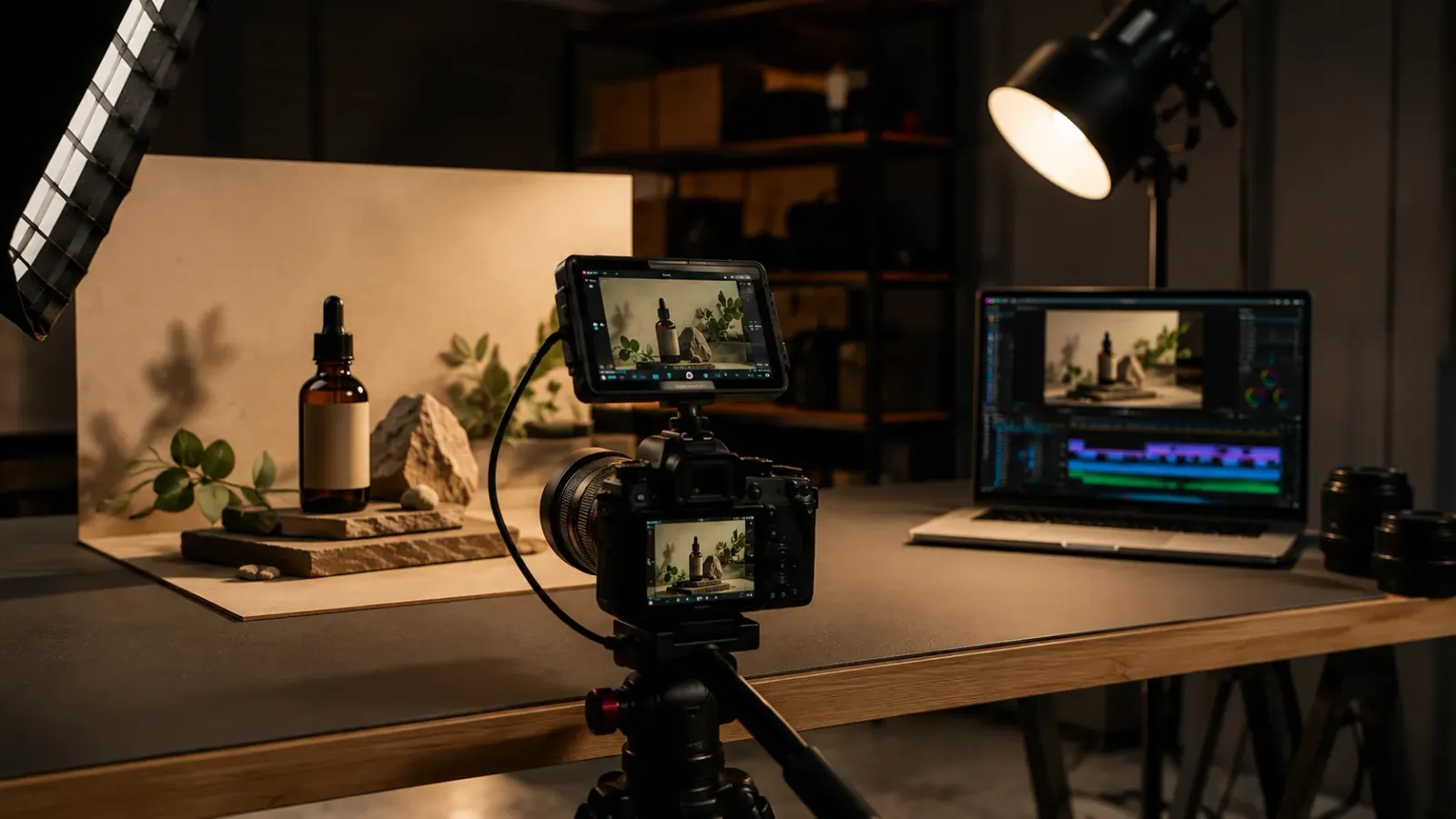
Adding a video to your Shopify product page is not the same as adding a video that lowers bounce rate and increases conversion. Most product videos on Shopify are too long, start too slowly, and are not optimized for silent autoplay on mobile. This editing checklist covers every decision that separates a product video that converts from one that gets scrolled past.

Dedicated Video Editor Service: When a Subscription Beats a Full-Time Hire
Most businesses that are considering hiring a full-time video editor have not run the real numbers. When you include benefits, equipment, software licenses, desk space, and management overhead, a full-time junior editor in the US costs $65,000 to $80,000 per year in total. This guide runs the full cost comparison and identifies the output threshold at which a subscription service wins on economics.
See if Editing Machine is the right fit for your content.
Take 90 seconds to tell us about your goals, content style, and volume. We'll show you which setup fits and exactly where to start.