Video Ad Hooks: 5 Ways to Stop the Scroll Immediately
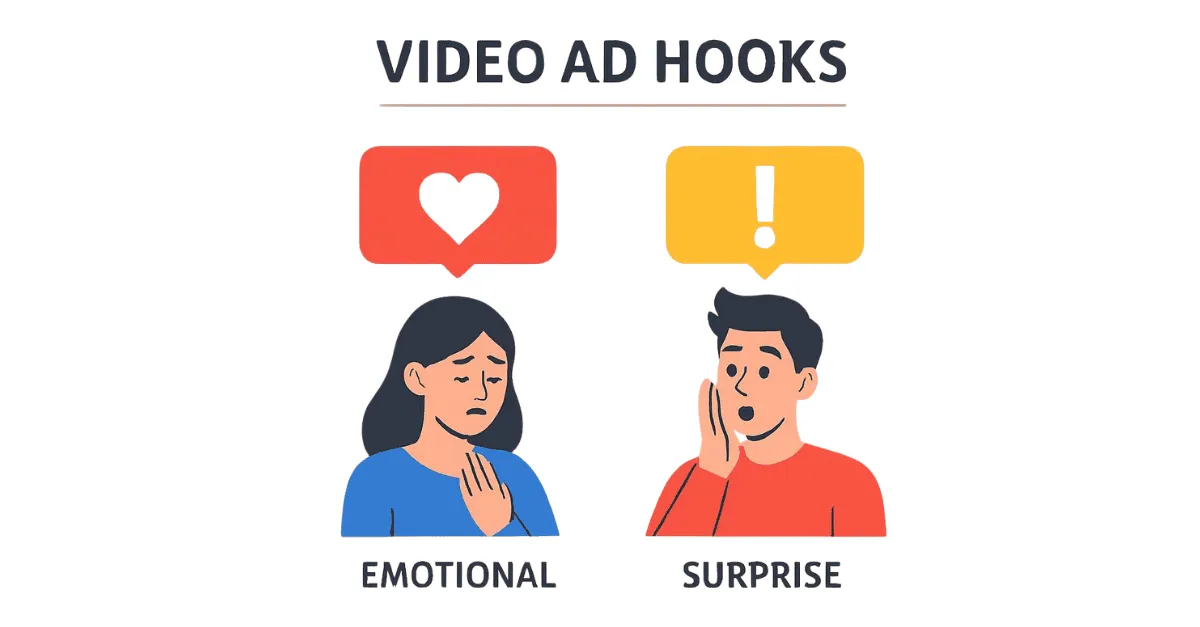
A brilliant product demonstration is completely worthless if viewers scroll past it in milliseconds. To survive the modern vertical feed, you must engineer physical roadblocks for the user's scrolling thumb. Discover five highly actionable visual and auditory pattern interrupts( from jarring ASMR and aggressive digital zooms to native UI glitches) guaranteed to paralyze the scroll and buy you the crucial three seconds needed to pitch your product.
Video Ad Hooks: 5 Ways to Stop the Scroll Immediately
What are the best video ad hooks? To create a high-converting stop scroll video, utilize these 5 proven video ad hooks:
-
Auditory Pattern Interrupt: Use jarring ASMR sounds, a loud clap, or sudden dead silence.
-
Aggressive Digital Zoom: Apply a rapid, unnatural punch-in cut directly to the speaker's face.
-
Negative Pain-Point Text: Flash a controversial or negative statement using native kinetic typography.
-
Out-of-Context Visual: Start with an oddly satisfying or visually confusing B-roll clip that demands an explanation.
-
UI 'Glitch' Overlay: Superimpose a recognizable system notification (like an iPhone text bubble) to trigger a subconscious response.
Every single day, the average social media user scrolls through the equivalent of 300 feet of content. Their thumb is locked in a relentless, subconscious rhythm, flicking past family photos, trending memes, and corporate advertisements with ruthless efficiency.
In this environment, the average human attention span is measured in fractions of a second. If you are launching a direct-to-consumer (DTC) advertising campaign with a "slow build-up", taking five seconds to establish a beautiful setting before delivering your value proposition, your view rate will be absolutely zero.
To survive the feed, you must engineer physical roadblocks for the user's thumb. This is the exclusive domain of highly effective video ad hooks.
The algorithm does not care about the brilliant product demonstration in the second half of your commercial if no one survives the first three seconds to see it. Your hook's sole purpose is not to sell the product; it is strictly to buy you the time to make the pitch.
This guide moves beyond broad theory and delivers pure, tactical execution. We will break down five highly actionable visual and auditory pattern interrupts guaranteed to create a high-converting stop scroll video.
Implementing these exact editing formulas into your post-production pipeline will allow your media buying team to immediately improve video hook rate and scale your brand profitably.
Anatomy of a Stop Scroll Video
Before deploying specific formulas, you must understand the operational structure of a modern advertisement. The most profitable DTC brands do not treat a video ad as a single, unchangeable file. They treat it as a modular asset.
A high-performing advertisement is divided into two distinct sections: the Hook (seconds 0 to 3) and the Body (seconds 4 to 30). You can take the exact same high-converting Body (a brilliant product demonstration and a strong call-to-action) and radically change its algorithmic performance simply by swapping out the first three seconds.
Treating the hook as a modular attachment allows your post-production team to generate dozens of high-value tests from a single filming session. (For a complete masterclass on how to execute this modular asset management, read our guide on Turning 1 Shoot into 10 Ad Variations (The Remix Strategy)).
Hook #1: Auditory Pattern Interrupt (ASMR & Silence)
When marketers design video ads, they become obsessed with visuals, completely forgetting that audio is half of the viewing experience. Most social feeds are a wall of loud, overlapping, generic background music. You can stop a user's scroll simply by breaking that auditory expectation.
ASMR Tactic
Autonomous Sensory Meridian Response (ASMR) utilizes hyper-crisp, magnified audio to trigger a physical psychological response. Instead of starting your ad with upbeat royalty-free music, start with a highly isolated, jarring sound effect.
Execution: If you are selling a beverage, the first second of the video should feature extreme, boosted audio of a soda can cracking open and fizzing. If you are selling apparel, use the loud, highly textured sound of heavy scissors shearing through thick fabric. This hyper-specific sound cuts through the noise of the feed, forcing the user's brain to pause and identify what they just heard.
Dead Silence Tactic
Alternatively, the complete absence of sound is a massive pattern interrupt.
Execution: Start the video with one full second of absolute, dead silence right before the creator speaks their first word.
When a user is rapidly swiping through a noisy feed and suddenly hits a pocket of pure silence, their brain registers a "glitch." They pause their thumb, assuming their phone speaker broke or their Bluetooth disconnected. You have just bought the crucial three seconds needed to deliver your text hook.
Hook #2: Aggressive Digital Zoom (Punch-In)
Digital platforms favor kinetic energy. If your creator is sitting perfectly still in a chair, speaking calmly into the camera, the feed will register the video as static and boring. You must manufacture visual momentum in post-production.
Tactic
The aggressive digital zoom (often referred to in editing bays as a "punch-in") creates artificial, propulsive movement. It physically forces the viewer's eye exactly where you want it: directly onto the speaker's mouth.
Execution: Your editor takes a static, wide shot of the creator. Within the first 1.5 seconds of the video, the editor applies two rapid, aggressive digital cuts.
-
Frame 1 (0.0s): Wide shot showing the creator's full torso.
-
Frame 2 (0.5s): Immediate cut zooming in 20% closer.
-
Frame 3 (1.0s): Immediate cut zooming in another 20%, framing the creator's face tightly.
These are not smooth, cinematic camera movements; they are jarring, rapid cuts that simulate the camera physically lunging forward. This aggressive visual pacing triggers a subconscious "flight or fight" micro-response, ensuring the viewer cannot look away. (To understand the theoretical retention metrics and algorithmic pacing rules behind this movement, review our deep dive in Hook Rate Optimization: Editing for the First 3 Seconds).
Hook #3: Negative Pain-Point Text Overlay
Human psychology is wired with a negativity bias. We are evolutionarily designed to pay closer attention to threats, complaints, and negative information than we are to positive affirmations.
Tactic
If your text overlay says, "This skincare cream is amazing!" the user's brain instantly categorizes the video as a corporate advertisement and ignores it. Positive claims are dismissed. However, negative claims, or controversial statements, trigger our survival and curiosity instincts.
Execution: Before the creator even finishes their first spoken sentence, your editor must place a massive, high-contrast text block directly in the center of the screen using native platform fonts. The text must agitate the target audience's core frustration.
-
Instead of: "The best way to clean your floors."
-
Use: "Stop ruining your hardwood floors with toxic bleach."
-
Instead of: "A great supplement for sleep."
-
Use: "Why melatonin is destroying your deep sleep."
This negative hook immediately identifies the target audience (people struggling with floors/sleep) and presents a threat. The user must stop scrolling to find out how to resolve the danger you just introduced.
Hook #4: Out-of-Context Visual (Oddly Satisfying)
The brain is a prediction machine. When a user scrolls, their brain tries to instantly predict what the video is about so it can decide whether to skip it. If you show them something their brain cannot immediately predict or categorize, you create a "cognitive gap."
Tactic
The cognitive gap forces the user to pause their thumb simply to figure out what they are looking at. The most effective way to utilize this is through "oddly satisfying" or out-of-context B-roll.
Execution: Open the advertisement with a 2-second, highly visual clip that has absolutely no obvious connection to your product, while your voiceover begins the actual sales pitch.
-
Show extreme macro footage of thick paint being scraped off a canvas.
-
Show a heavy object crushing a piece of floral foam.
-
Show a pressure washer cleaning a single strip of concrete.
The visual is mesmerizing, and the brain demands an explanation. While the viewer watches the satisfying visual, they are simultaneously listening to your voiceover. By the time the B-roll ends at the 3-second mark and cuts back to your product, you have successfully hijacked their attention.
Hook #5: Native UI 'Glitch' Overlay
We are trained like Pavlov's dogs to respond to our smartphones. When we see a notification banner drop down, or hear a text chime, our immediate reflex is to check the message. You can leverage this ingrained, subconscious habit directly in the editing timeline.
Tactic
Superimposing recognizable system notifications over your video allows you to trigger a physiological response before the user's conscious brain realizes they are watching an advertisement.
Execution: Your editor utilizes motion graphics to simulate a native user interface (UI) overlay during the first two seconds of the video.
-
iMessage Overlay: Edit a highly realistic green or blue text message bubble popping up at the top of the screen. The text inside the bubble should deliver the core hook (e.g., Mom: "Did you finally buy that new serum?").
-
Calendar Alert: Flash a fake calendar reminder on the screen that says, "Reminder: Fix your posture today." * FaceTime Call: Start the video with the classic "Incoming Call" screen before the creator "answers" it and begins talking.
The thumb stops because the brain is momentarily tricked into reading the "notification." Once the text is read, you transition seamlessly into the ad body.
How to Test Multiple Hooks at Scale
Understanding these five psychological triggers is valuable, but reading a listicle will not drop your CPA. The operational reality of media buying is that you cannot just pick one of these hooks, guess that your audience will like it, and hope it works. You must test all five simultaneously.
Operational Reality
What works for a fitness apparel brand might fail miserably for a B2B software company. The ASMR audio hook might yield a $10 CPA, while the negative text hook yields a $45 CPA.
You must let the data dictate the winner. This requires an editing team capable of taking one core ad and exporting five distinct, perfectly formatted variations within 24 hours. (For the exact blueprint on how to structure this daily workflow, read High-Volume Creative Testing: The 2026 DTC Playbook).
Editing Machine Solution
Executing high-volume hook testing requires an industrial-grade post-production pipeline. Solo freelancers will inevitably bottleneck this process.
At Editing Machine, DTC media buyers simply drop their raw creator footage into our centralized portal. They request the "5-Hook Matrix." Our hybrid team of elite editors takes that single raw file, applies the aggressive digital zooms, engineers the ASMR audio spikes, layers the native UI glitches, and returns a fully realized batch of variations overnight. You receive a complete testing suite ready to upload to Facebook Ads Manager, allowing you to find the cheapest clicks without stressing over timeline rendering.
Learn More: How Editing Machine Works for ads.
In Conclusion
A brilliant product demonstration, a perfectly optimized landing page, and a massive media buying budget are all completely worthless if nobody sticks around to watch your video. In the vertical feed, you are not competing against other brands; you are competing against the relentless, scrolling momentum of the user's thumb.
You must engineer your introductions aggressively. Leveraging auditory pattern interrupts, digital punch-ins, cognitive gaps, negative text, and UI glitches will allow you to seize control of the first three seconds.
Stop letting bad hooks ruin your ROAS. You have the strategy; now you need the execution. Let the Editing Machine team build, format, and execute high-converting hook variations for your next major ad campaign. Create your Editing Machine account today, and turn your raw footage into an unstoppable scrolling roadblock.
FAQs
Q: What are video ad hooks? A: Video ad hooks are highly engineered visual, auditory, or psychological pattern interrupts placed in the very first 1 to 3 seconds of a social media advertisement. Their sole purpose is to immediately break a user's scrolling momentum, capture their conscious attention, and buy the advertiser enough time to deliver the core product pitch or value proposition.
Q: How do you create a stop scroll video? A: To create an effective stop scroll video, you must aggressively disrupt the user's expected feed experience. This is achieved through rapid, deliberate post-production techniques, such as applying aggressive digital zooms (punch-ins), utilizing native UI notification overlays, leveraging jarring ASMR sound design, or flashing negative, pain-point-driven kinetic text on the screen within the very first second.
Q: What is the fastest way to improve video hook rate? A: The fastest way to improve video hook rate is to execute a high-volume, modular testing strategy. Because different audiences respond to different psychological triggers, you should film one core video body and use a professional editing service to attach 5 to 10 distinct, unique hooks to the front of the video. By launching all variations simultaneously, dashboard data will instantly reveal which specific pattern interrupt retains attention best.
More from the Blog
Video Content Repurposing: The 10x Multiplier Framework
Most content creators treat repurposing as something they do when they have time, which means they almost never do it. The 10x Multiplier Framework treats it as the default production model: every recording session is planned with repurposing built in from the start, and every edited asset points toward the next format. This guide covers the full framework and the specific formats each recording type should produce.
Shopify Product Video: The Editing Checklist That Lowers Bounce Rate
Adding a video to your Shopify product page is not the same as adding a video that lowers bounce rate and increases conversion. Most product videos on Shopify are too long, start too slowly, and are not optimized for silent autoplay on mobile. This editing checklist covers every decision that separates a product video that converts from one that gets scrolled past.
Dedicated Video Editor Service: When a Subscription Beats a Full-Time Hire
Most businesses that are considering hiring a full-time video editor have not run the real numbers. When you include benefits, equipment, software licenses, desk space, and management overhead, a full-time junior editor in the US costs $65,000 to $80,000 per year in total. This guide runs the full cost comparison and identifies the output threshold at which a subscription service wins on economics.
See if Editing Machine is the right fit for your content.
Take 90 seconds to tell us about your goals, content style, and volume. We'll show you which setup fits and exactly where to start.