Dedicated Video Editor Service: When a Subscription Beats a Full-Time Hire
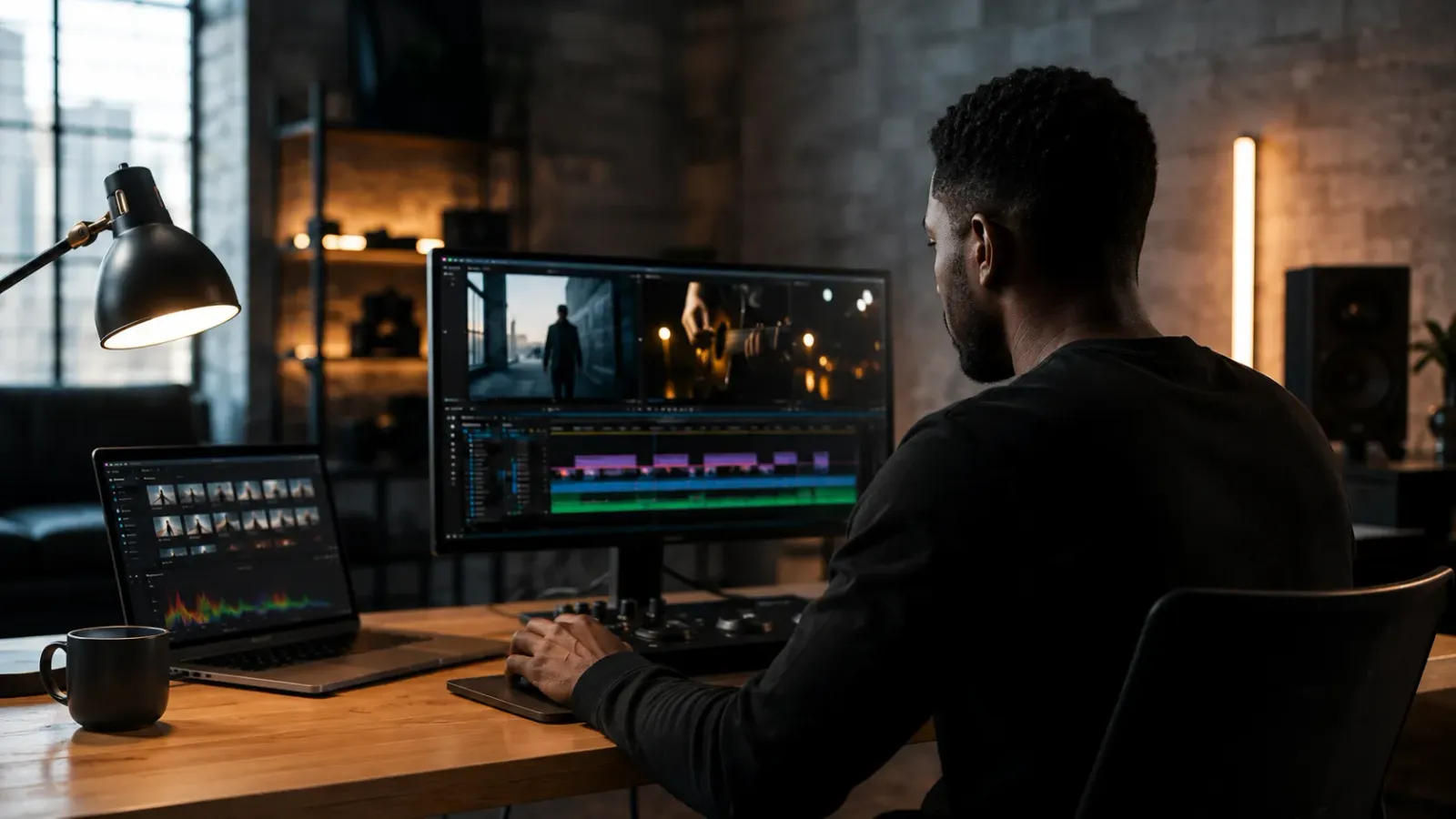
Most businesses that are considering hiring a full-time video editor have not run the real numbers. When you include benefits, equipment, software licenses, desk space, and management overhead, a full-time junior editor in the US costs $65,000 to $80,000 per year in total. This guide runs the full cost comparison and identifies the output threshold at which a subscription service wins on economics.
Dedicated Video Editor Service: When a Subscription Beats a Full-Time Hire
What Is a Dedicated Video Editor Service? A dedicated video editor service assigns a specific editor or editing team to your account on a subscription basis, providing consistent turnaround, brand familiarity, and predictable monthly pricing without the fixed costs of a full-time hire. You get the benefits of a long-term editing relationship, defined capacity, and documented brand standards, without the salary, benefits, equipment costs, and management overhead that come with an in-house employee.
Key Takeaways:
The Real Cost of a Full-Time Editor Is Not the Salary: Benefits, equipment, software, management time, and recruiting costs push the true cost of a full-time junior editor to $65,000 to $85,000 per year in most US markets.
The Break-Even Is Around 4 to 6 Videos Per Month: Below that volume, a subscription costs more per video than a freelancer. Above it, the economics shift decisively toward a subscription because the per-video cost drops while consistency and speed improve.
The Subscription Removes the Management Overhead: The hidden cost of any editing arrangement is the hours spent briefing, reviewing, and managing the editor. A well-structured subscription with a documented Brand Profile reduces this to near zero after the first project.
The Hiring Decision Most Businesses Get Wrong
At some point, most growing brands that produce regular video content face the same decision: hire a full-time video editor or continue outsourcing. The instinct is often to hire, because having someone in-house feels more controllable, more committed, and more efficient than managing an external relationship.
That instinct is not wrong in every case. But most businesses make the decision without running the real numbers. The salary is the most visible cost and also the smallest part of the total cost of employment. When you include everything a full-time editor actually costs, the economics look very different.
Chapter 1: The True Cost of a Full-Time Video Editor
Cost Category | Annual Cost (US Market) | Notes |
Base salary (junior to mid-level) | $45,000 to $65,000 | US average for 1 to 3 years experience |
Employer payroll taxes | $6,000 to $9,000 | Approximately 13 to 15 percent of salary |
Health insurance contribution | $6,000 to $8,000 | Employer contribution only |
Hardware (computer, monitors) | $3,000 to $5,000 | Amortized over 3 years |
Software (Adobe CC, storage) | $2,000 to $3,500 | Annual licenses and cloud storage |
Paid time off (15 to 20 days) | $2,600 to $5,000 | Salary cost of non-working days |
Recruiting and onboarding | $3,000 to $8,000 | One-time cost amortized over tenure |
Management overhead | $5,000 to $15,000 | Internal management time at $50 to $75 per hour |
TOTAL | $72,600 to $119,500 | Per year, before any productivity or output risk |
The salary looks reasonable in isolation. The total loaded cost of employment looks very different. For a business producing fewer than six videos per month, this math almost never works in favor of hiring.
Chapter 2: What a Dedicated Editing Subscription Actually Costs
Dedicated video editing subscription services typically range from $500 to $2,500 per month, depending on volume, format complexity, and turnaround time guarantees. At the midpoint of $1,000 per month, the annual cost is $12,000. At the upper end of $2,500 per month, the annual cost is $30,000.
At $12,000 to $30,000 per year, a subscription costs between 15 and 40 percent of the fully-loaded cost of a mid-level full-time editor. And unlike a full-time employee, a subscription carries zero fixed cost exposure: if your video production volume drops, you adjust the plan. If you need to exit the relationship, there is no severance, no notice period, and no HR process.
For a full breakdown of how the pricing models across different editing services compare, including the hidden costs that do not appear in the headline rate, see our guide on Video Editing Rates in 2026: Freelancer vs Agency vs Subscription.
Chapter 3: The Volume Threshold Where Each Model Wins
Monthly Video Volume | Best Model | Why |
1 to 3 videos | Freelancer | Low volume does not justify subscription minimums |
4 to 8 videos | Subscription | Consistent output, predictable cost, faster turnaround than freelancer management allows |
9 to 20 videos | Subscription | Volume scales within the plan, per-video cost drops, no hiring required |
20 or more videos | Subscription or hybrid | High volume justifies premium subscription tier or supplementing with in-house for specialised work |
40+ hours of editing per week | Consider full-time hire | Only at this volume does a full-time hire begin to approach economic parity with a subscription |
Chapter 4: What the Full-Time Hire Gets You That a Subscription Does Not
Being honest about this matters. A full-time in-house editor does provide things a subscription cannot perfectly replicate:
● Real-time collaboration: An in-house editor can sit in a review session and implement feedback live. A subscription operates on a submit-and-receive workflow with a defined turnaround.
● Deep institutional knowledge: An editor who has worked on your content for two years knows things that cannot be fully documented in a Brand Profile: the founder's on-camera quirks, the preferred music energy for different campaign types, the unwritten rules of the brand voice.
● Specialist skills: If your content requires highly specialized technical work (complex motion graphics, proprietary plugin workflows, or hardware-specific editing), a subscription generalist may not match the depth of a hired specialist.
These are real advantages in specific contexts. They are also advantages that only materialize at relatively high production volumes, typically 20 or more videos per month, where the relationship has had enough time to develop. For most businesses below that volume, the subscription wins on economics and the brand familiarity gap is closed by a well-structured brief and Brand Profile.
For more on how the pod-based subscription model handles brand consistency without a single dedicated individual, see our guide on Fractional Video Editing Teams: The System vs. The Person.
Chapter 5: The Management Overhead Nobody Puts in the Spreadsheet
The comparison above does not include one cost that is almost always omitted from hiring analyses: the time cost of managing an editor, whether freelance, full-time, or subscription.
Managing a freelancer costs an estimated 2 to 4 hours per video in briefing, review, and revision coordination. At 8 videos per month and an internal hourly cost of $60, that is $960 to $1,920 per month in invisible labor. Managing a full-time editor costs less per video in briefing time but more in total management overhead across feedback cycles, performance management, and onboarding.
A subscription service with a documented Brand Profile and a standardized brief reduces this overhead dramatically. After the first project, the brief is largely pre-filled, the editor knows the brand standards, and revisions are uncommon because the quality baseline is established. For the framework that makes this work in practice, see our guide on An Expert's Guide to Outsourcing Video Editing.
And for the argument that the speed of production is itself a financial variable that most businesses underweight, see our piece on Why Time-to-Publish Matters More Than Cost-Per-Video.
Frequently Asked Questions
Q: What is a dedicated video editor service?
A: A dedicated video editor service assigns a specific editor or editing team to your account on a subscription basis, giving you consistent turnaround, brand familiarity, and predictable monthly pricing without the fixed costs of a full-time hire.
Q: Is it cheaper to hire a full-time video editor or use a subscription service?
A: At most output volumes, a subscription is significantly cheaper. A full-time junior editor in the US costs $45,000 to $65,000 in salary alone, plus benefits, equipment, software, and management overhead. A subscription delivering the same volume typically costs $6,000 to $30,000 per year with no fixed cost exposure.
Q: What is the difference between a dedicated video editor and a freelancer?
A: A freelancer is available on demand with no commitment to your brand and can go silent without notice. A dedicated editing service provides a guaranteed capacity allocation, documented brand standards, and a team structure that eliminates the single point of failure a solo freelancer creates.
Q: When does it make sense to hire a full-time video editor instead of a subscription?
A: A full-time hire makes sense when your daily video output justifies 40 hours of editing per week, when your content requires highly specialized skills that cannot be documented into a brief, or when real-time physical collaboration is essential to the workflow.
Get a dedicated editing team without the hiring overhead. Editing Machine delivers consistent, fast, brand-aligned video at a fixed monthly cost. No salary, no benefits, no management overhead. See our pricing.
More from the Blog
Video Content Repurposing: The 10x Multiplier Framework
Most content creators treat repurposing as something they do when they have time, which means they almost never do it. The 10x Multiplier Framework treats it as the default production model: every recording session is planned with repurposing built in from the start, and every edited asset points toward the next format. This guide covers the full framework and the specific formats each recording type should produce.
Shopify Product Video: The Editing Checklist That Lowers Bounce Rate
Adding a video to your Shopify product page is not the same as adding a video that lowers bounce rate and increases conversion. Most product videos on Shopify are too long, start too slowly, and are not optimized for silent autoplay on mobile. This editing checklist covers every decision that separates a product video that converts from one that gets scrolled past.
TikTok Ad Creative: What the Top 1% Look Like in the Edit
The single most common mistake in TikTok ad creative is making it look like an ad. Over-produced visuals, logo animations, and clean brand voice immediately signal advertising to a platform audience trained to scroll past exactly that. This guide breaks down the editing decisions that make the difference between a TikTok ad that converts and one that gets scrolled past in under a second.
See if Editing Machine is the right fit for your content.
Take 90 seconds to tell us about your goals, content style, and volume. We'll show you which setup fits and exactly where to start.