TikTok Ad Creative: What the Top 1% Look Like in the Edit
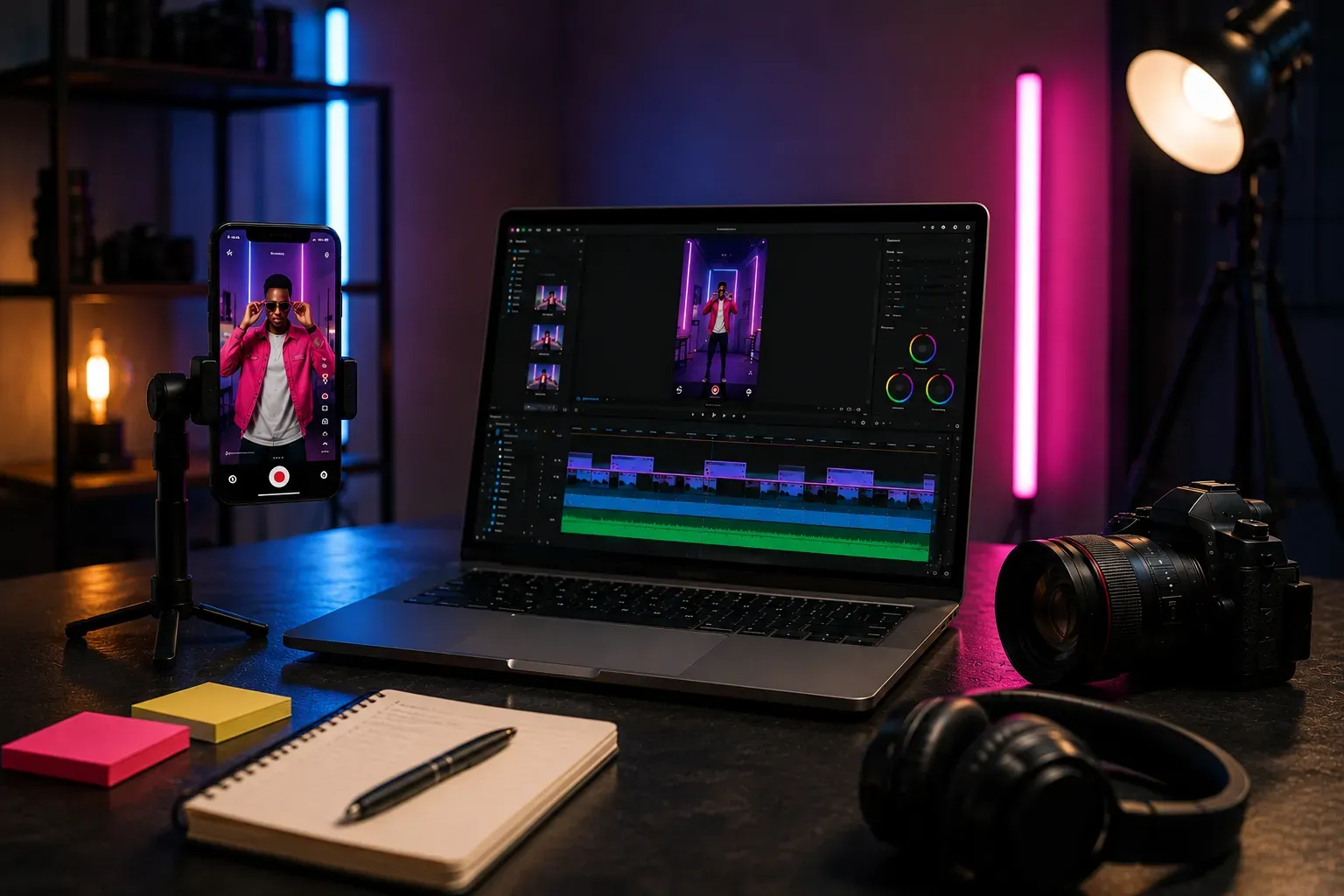
The single most common mistake in TikTok ad creative is making it look like an ad. Over-produced visuals, logo animations, and clean brand voice immediately signal advertising to a platform audience trained to scroll past exactly that. This guide breaks down the editing decisions that make the difference between a TikTok ad that converts and one that gets scrolled past in under a second.
TikTok Ad Creative: What the Top 1% Look Like in the Edit
What Makes Top-Performing TikTok Ad Creative? The best-performing TikTok ads are editorially indistinguishable from organic TikTok content. They use platform-native pacing (fast, with frequent cuts), sound-on audio including trending sound elements or direct-address spoken hooks, text overlays in the first one to two seconds, and no visual signals that announce advertising production (no animated logos, no brand bumpers, no studio lighting that reads as produced rather than genuine). The hook appears within the first second, the conflict or promise is resolved within 15 to 30 seconds, and the CTA is stated rather than animated.
Key Takeaways:
Native Beats Produced: TikTok audiences are trained to skip content that looks like an ad. Creative that matches the visual language of organic content consistently outperforms polished brand advertising on this platform.
Sound-On Is the Default: Unlike Meta or LinkedIn where most viewing is sound-off, TikTok is a sound-on platform. Audio hooks, voiceovers, and trending sounds are not optional additions. They are structural elements of the creative.
The First Second Is the Only Second That Matters: A TikTok scroll takes less than a second. The hook must work before the viewer decides whether to keep scrolling, which means it must be identifiable in the first frame of a silent autoplay.
Why Most TikTok Ads Fail Before Anyone Watches Them
TikTok's algorithm surfaces content based on engagement signals: completion rate, shares, comments, and saves. Ads that are skipped immediately generate a negative engagement signal. Ads that are watched, engaged with, and completed generate a positive one, regardless of whether the viewer knew they were watching an ad.
The platform's ad delivery system rewards creative that performs like organic content. Which means the first and most important creative decision for TikTok advertising is not budget, targeting, or bidding strategy. It is whether the video looks and feels like something a real person would post.
Most brand advertisers fail this test immediately. An opening with a logo animation, a voiceover with studio-quality polish, or a visual style that clearly came from a production company rather than a phone is identified as an ad within the first second and scrolled past before a single message is communicated.
Chapter 1: The Native-First Editing Standard
Aspect Ratio and Frame
9:16 vertical format fills the full screen, which is the baseline. Beyond that, the frame composition matters. Organic TikTok is typically shot handheld or on a phone, with natural framing rather than perfectly centered studio composition. An ad shot on a professional camera can still look native if it is framed and graded to match the aesthetic of the content around it in the feed. An ad shot on a phone but over-lit and over-produced still reads as advertising.
Pacing
TikTok's organic content uses faster cuts than almost any other video platform. Attention cycles on TikTok are shorter, trained by years of high-velocity content consumption. An ad that uses the same pacing as a YouTube video or a Facebook ad will feel slow against the surrounding feed content and lose viewer attention at a structurally faster rate than the same creative would lose it on a different platform.
The editing standard for TikTok ads: cuts every 1.5 to 3 seconds for talking-head or product footage, text overlays that appear and disappear within 1 to 2 seconds each, and a visual change (cut, overlay, zoom, or graphic element) at every natural speech pause.
Audio Treatment
Sound design in TikTok ads should not feel like sound design. Trending audio elements, whether a recognizable music snippet, a sound effect associated with a specific content category, or a voiceover delivered in the same direct, conversational tone as a native creator, reduces the psychological distance between the ad and the surrounding organic content.
Professional voiceovers in a formal broadcast register are the audio equivalent of a logo animation. They signal production. Replace them with direct-address delivery recorded at conversational quality, not studio quality.
Chapter 2: The Hook Architecture
The hook is the single most important element of TikTok ad creative. Given that the decision to scroll or stay takes less than one second, the hook must operate in two layers simultaneously: the visual layer (what appears on screen in the first frame) and the audio layer (what is said in the first spoken sentence or text overlay).
Visual Hook
The first frame of the video must contain a visual that creates tension, curiosity, or recognition without requiring any audio. A product in an unexpected context. A before state that is visually uncomfortable or relatable. A text overlay with a bold claim. An action already in progress that the viewer wants to see resolved.
Static first frames, brand assets, or empty establishing shots waste the most valuable second of the entire creative and should be replaced with the highest-energy or most visually arresting moment from anywhere in the footage.
Verbal Hook
The first spoken sentence should state the core claim, the problem, or the contrarian insight that the rest of the video substantiates. Not context. Not an introduction. The claim itself. Opening with "Most people do X wrong..." or "I tested this for 30 days and here is what happened" creates a specific curiosity that only the rest of the video resolves.
For the full framework on engineering hooks across video formats and platforms, see our guide on Hook Rate Optimization: Editing for the First 3 Seconds.
Chapter 3: The Creative Testing Framework for TikTok
TikTok's ad system is built around creative iteration. The algorithm optimizes delivery toward the strongest-performing creative in an ad set, which means testing multiple variants is not a nice-to-have. It is the mechanism by which TikTok advertising actually works.
Top-performing DTC brands on TikTok run three to five creative variants per ad set, each testing a single variable. The most common test variables, in order of impact:
● Hook: Same product, same offer, different opening five seconds. This is the highest-leverage test because the hook determines whether the creative earns a watch at all.
● Format: UGC-style versus direct-to-camera versus voiceover-driven. Different format styles reach different audience segments even with identical targeting.
● Presenter: Different faces performing the same hook. This tests audience affinity and demographic resonance.
● Offer framing: Same product, different angle on the value proposition. Price versus convenience versus outcome versus social proof.
For the systematic approach to managing creative testing at scale, see our guide on High-Volume Creative Testing: The 2026 DTC Playbook. And for the UGC editing approach that produces the native-feeling creative that outperforms produced ads on TikTok, see our guide on UGC Video Editing for Ads: Scaling Authenticity.
Chapter 4: Extracting Multiple TikTok Variants from a Single Shoot
The volume of creative TikTok requires makes per-video production economics unsustainable for most DTC brands. The solution is extracting multiple distinct creatives from a single recording session, changing hooks, reordering footage, and varying the text overlay to produce three to five structurally different ads from the same raw material.
For the framework that systematically extracts maximum creative variation from a single shoot, see our guide on Turning 1 Shoot into 10 Ad Variations: The Remix Strategy. For the editing differences between TikTok, Reels, and Shorts that determine how the same source footage needs to be adapted for each platform, see Shorts vs TikTok vs Reels: Editing Choices That Matter.
Frequently Asked Questions
Q: What makes TikTok ad creative different from other platforms?
A: TikTok ads that perform best are indistinguishable from organic TikTok content in their visual style, pacing, and audio use. Unlike Meta or YouTube ads where production quality signals trust, on TikTok over-produced content reads as an ad and gets scrolled past. Native-feeling creative, sound-on editing, and a hook that does not announce itself as advertising are the defining characteristics.
Q: How long should a TikTok ad be?
A: 15 to 30 seconds performs best for most direct response objectives. TikTok's own research suggests ads under 21 seconds have the highest completion rates. For complex products or higher-ticket offers, 45 to 60-second ads can perform well if the hook and first five seconds earn the extended watch time.
Q: What is the best hook format for TikTok ads?
A: Text overlays in the first one to two seconds stating a bold claim, a question, or a contrarian statement perform strongly. Verbal hooks delivered directly to camera with high energy also work well. The hook should create a specific tension that only the rest of the video resolves.
Q: How many TikTok ad creatives should I be testing at once?
A: Three to five creative variants per ad set is the standard starting point. Each variant should test one variable: hook, format, presenter, or offer framing. Fewer than three gives the algorithm insufficient signal. More than five dilutes spend before any variant reaches statistical significance.
Need TikTok creatives that actually stop the scroll? Editing Machine produces native-first TikTok ad creative, UGC-style cuts, hook variants, and multi-format delivery, fast enough to keep up with a testing cadence. Start Creating Now.
More from the Blog
Video Content Repurposing: The 10x Multiplier Framework
Most content creators treat repurposing as something they do when they have time, which means they almost never do it. The 10x Multiplier Framework treats it as the default production model: every recording session is planned with repurposing built in from the start, and every edited asset points toward the next format. This guide covers the full framework and the specific formats each recording type should produce.
Shopify Product Video: The Editing Checklist That Lowers Bounce Rate
Adding a video to your Shopify product page is not the same as adding a video that lowers bounce rate and increases conversion. Most product videos on Shopify are too long, start too slowly, and are not optimized for silent autoplay on mobile. This editing checklist covers every decision that separates a product video that converts from one that gets scrolled past.
Dedicated Video Editor Service: When a Subscription Beats a Full-Time Hire
Most businesses that are considering hiring a full-time video editor have not run the real numbers. When you include benefits, equipment, software licenses, desk space, and management overhead, a full-time junior editor in the US costs $65,000 to $80,000 per year in total. This guide runs the full cost comparison and identifies the output threshold at which a subscription service wins on economics.
See if Editing Machine is the right fit for your content.
Take 90 seconds to tell us about your goals, content style, and volume. We'll show you which setup fits and exactly where to start.