How AI is Changing Post-Production (The Hybrid Manifesto)
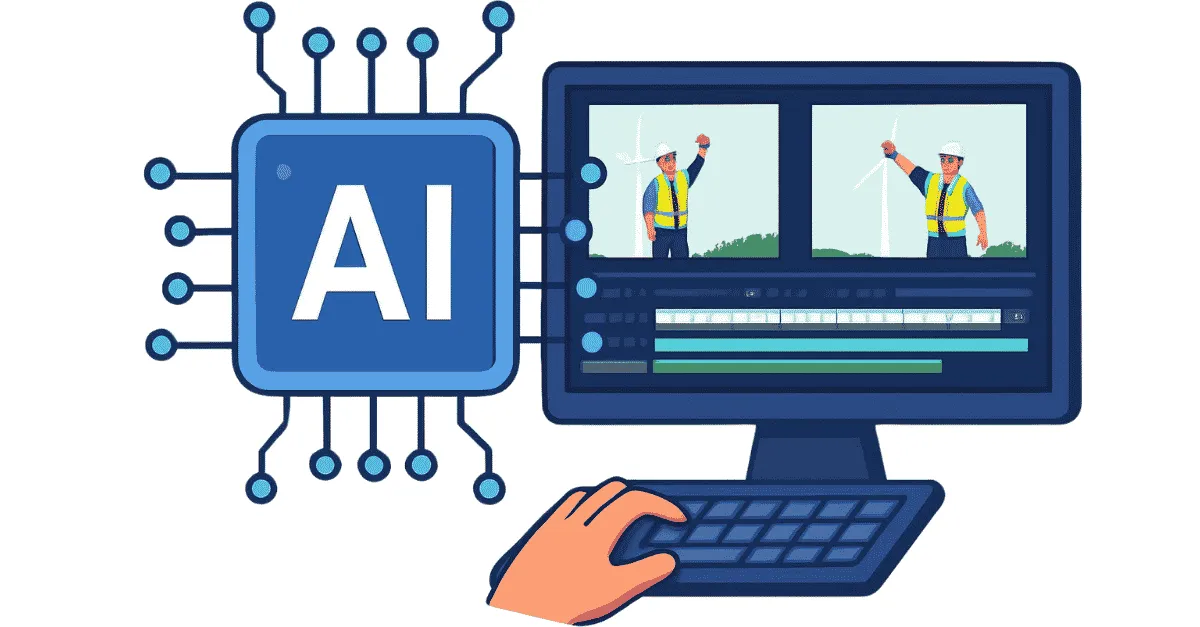
The creative industry is currently paralyzed by a false choice: stick to slow, expensive manual editing, or surrender to soulless, one-click AI generators. But the most profitable agencies and brands aren't choosing sides. Rather, they are building a hybrid pipeline. Learn why the smartest post-production teams are using AI to bulldoze through tedious administrative tasks, freeing human editors to focus entirely on the emotional storytelling and visual hooks that actually drive conversions.
How AI is Changing Post-Production (The Hybrid Manifesto)
What is the role of AI in video editing?
The role of AI in video editing is to automate the technical, time-consuming administrative tasks of post-production: such as audio transcription, color balancing, silence removal, and rough-cut assembly.
Hybrid Model: In professional post-production, AI does not replace the human editor. Instead, the "AI + Human" model uses AI video tools to handle the mechanical foundation, thus allowing the human editor to focus entirely on creative storytelling, emotional pacing, and strategic visual hooks to drive engagement.
We discuss this topic in great detail in this blog post.
Open LinkedIn or Twitter on any given day, and you will see the same polarizing headlines: "AI is going to replace all video editors by next year!" followed immediately by, "AI video is a soulless fad that will destroy brand trust!"
The creative industry is currently gripped by panic and hyperbole. On one end of the spectrum, you have the "Traditional Purists" (agencies and freelancers who refuse to integrate AI, insisting that every single frame must be cut manually). They charge exorbitant hourly rates to perform administrative tasks that a computer could do in seconds.
On the other end of the spectrum, you have the "Automation Bros." These are software companies selling the dream of the "One-Click Ad." They promise that you can upload a script, click a button, and an algorithm will spit out a finished, high-converting video with zero human intervention.
Both of these extremes are fundamentally wrong.
The successful implementation of ai in video editing is not about choosing between man and machine. It is about understanding what each does best. The future of post-production does not belong to robots, and it does not belong to stubborn traditionalists. The future belongs to cyborgs.
At Editing Machine, we believe that trying to automate human empathy is a fool’s errand, but paying a human to do a robot's job is a waste of your marketing budget. This is our Hybrid Manifesto: We use AI to do the heavy lifting, and we use humans to do the storytelling.
(This philosophy is the operational backbone of our An Expert's Guide to Outsourcing Video Editing in 2026 series ).
Myth of the "One-Click" AI Editor
To understand the hybrid model, we must first dismantle the myth that fully automated ai video tools can run a successful marketing campaign.
What is the Problem with AI-Only Generation?
Generative AI and automated assembly algorithms are incredibly impressive feats of engineering. However, they are built on a fundamental limitation: AI only understands data patterns; it does not understand human emotion.
Direct-response marketing and brand building are entirely reliant on emotional resonance. You are not just conveying information; you are trying to make the viewer feel something: urgency, trust, humor, or relief.
What is the Empathy Deficit in Ai?
An AI editor does not understand sarcasm. It does not understand the comedic timing required to hold a silent pause for exactly 1.5 seconds before delivering a punchline. It does not understand that a subtle raise of an eyebrow in the B-Roll perfectly contradicts the audio in a way that creates an engaging "Pattern Interrupt."
When you rely entirely on one-click ai video tools, the result is uncanny. The cuts happen perfectly on the beat of the music, the captions pop up with grammatical perfection, and the color is mathematically balanced. Yet, the video feels entirely generic. It feels like a template. And on platforms like TikTok and Instagram, users can smell a template from a mile away. They will scroll past it in milliseconds.
AI can synthesize the pixels, but it cannot synthesize the soul.
What AI Actually Solves (Admin Burden)
If AI cannot tell the story, what is it good for? The answer is: Everything else.
"Shovel vs. Bulldozer" Analogy
For the last twenty years, video editing has been a grueling administrative process. An editor spends roughly 80% of their time on file organization, technical setup, and mechanical cutting, and only 20% of their time actually being creative.
AI changes this ratio. AI is not a replacement for the artist; it is a bulldozer that replaces the shovel.
Transcription & Captions
Consider the process of adding text to a video. As we explored in Captions vs. Subtitles: Engagement Impact Study, dynamic text is mandatory for modern social media.
Five years ago, an editor had to listen to the video, type out the words manually, and chop up the text blocks on the timeline to sync them with the speaker’s lips. It was mind-numbing manual labor.
Today, AI transcribes the audio and maps it to the exact frame timing in less than ten seconds.
Audio Syncing & Silence Removal
When shooting a podcast with three different cameras and four different microphones, an editor used to spend hours manually aligning the audio waveforms so the video synced with the sound. Then, they had to comb through a 60-minute file to manually cut out every "umm," "ahh," and breath.
Today, AI aligns the multi-cam sequences instantly. It maps the silence and automatically removes dead air with mathematical precision, delivering a cleaned-up "rough cut" before the human editor even touches the mouse.
Baseline Color and EQ
Instead of a human spending 30 minutes twisting digital dials to fix a harsh fluorescent light or remove the background hum of an air conditioner, AI noise-reduction and auto-balancing algorithms fix the baseline technical errors instantly.
AI does not replace the editor; it replaces the tedium.
"AI + Human" Pipeline (Editing Machine’s Way)
So, what does this look like in practice? At Editing Machine, we have built a proprietary production pipeline that perfectly balances algorithmic speed with human taste. We call it the Hybrid Pipeline.
Phase 1: AI Foundation
When you submit your raw footage through the Editing Machine portal, our AI infrastructure immediately goes to work. Before a human editor is even assigned to the project, the system:
-
Syncs all external audio and multi-cam footage.
-
Removes background noise, hums, and echoes using AI audio enhancement.
-
Automatically cuts out dead space and filler words to tighten the pacing.
-
Generates a frame-accurate text transcript for the captions.
We compress 4 hours of traditional manual labor into 4 minutes of computing time.
Phase 2: Human Architect
This is where the magic happens. A highly trained human editor logs into the project. Because the AI has already handled the mechanical prep work, the editor starts with a clean, synced timeline.
They do not have to waste their mental energy typing out captions. Instead, they spend 100% of their cognitive bandwidth on strategy:
-
Which 3-second clip should I pull to the front to act as the Hook?
-
How can I manipulate the pacing to build tension before the Call to Action?
-
Which B-roll shot evokes the strongest emotional response?
-
How can I stylize the AI-generated text with the brand's exact colors and emojis to make it pop?
Output
The result of the Hybrid Pipeline is an unfair advantage for our clients. You get the lightning-fast turnaround times and cost-efficiency of automation, combined with the emotional resonance, strategic nuance, and strict quality control of a human artist.
Learn more about how Editing Machine works and how we can help your business.
Evolution of the Editor: From "Button Pusher" to "Director"
We are witnessing a massive paradigm shift in creative labor. The future of video editing dictates that editors will no longer be valued for their mechanical speed. Knowing the keyboard shortcuts for Adobe Premiere Pro is no longer a competitive advantage; the AI can push the buttons faster than you can.
The Rise of the Strategic Director
In the hybrid era, human editors are elevated. They transition from being "Button Pushers" to being "Directors of Output."
Their value is derived from their taste. It is derived from their understanding of consumer psychology, their knowledge of algorithmic platform trends, and their ability to curate and mold AI-generated assets into a cohesive, high-converting narrative.
At Editing Machine, we don't hire people who are just fast at cutting clips. We hire creative strategists who know how to wield AI as a tool to execute a broader marketing vision.
Why Brands Must Adopt the Hybrid Model Today
For marketing agencies, DTC founders, and high-volume content creators, adopting the Hybrid Model is not just about keeping up with trends; it is a matter of financial survival.
What is the Cost of Ignoring It?
If you are currently paying a traditional freelancer or a boutique agency $100 to $150 per hour to edit your videos, you are burning cash. You are paying premium human rates for them to sit at a desk and manually transcribe text or sync audio files. You are paying for their inefficiency.
The Scale Factor
Modern advertising platforms demand volume. You cannot survive by testing one new video ad a month; you need to test ten variations a week to fight ad fatigue.
A traditional human-only pipeline physically cannot produce that volume without bloating your payroll with a massive in-house team. A fully automated AI generator will produce the volume, but the quality will be so low that your CPA (Cost Per Acquisition) will skyrocket.
The Hybrid Model is the only scalable fulfillment strategy. It lowers the Cost of Goods Sold (COGS) by utilizing AI for the grunt work, allowing the human talent to pump out high-quality, emotionally resonant variations at a fraction of the traditional cost.
In Conclusion
When the camera was invented, painters panicked. They thought art was dead because a machine could capture reality instantly. But the camera didn't kill art; it just eliminated the need to spend 40 hours painting a realistic portrait. It freed humans to invent Impressionism, Cubism, and Abstract art. The machine handled the replication; the human handled the imagination.
The exact same thing is happening right now in post-production. AI is not going to replace the video editor. It is going to eliminate the boring, repetitive parts of the job, forcing editors to become pure storytellers.
The future is Hybrid.
Stop paying for manual labor. Stop settling for robotic AI edits. Experience the perfect balance of speed, scale, and storytelling. Create your Editing Machine Account today to see how the Editing Machine platform uses the "AI + Human" pipeline to deliver the best creative assets in the industry.
FAQs
Q: Will AI replace video editors? A: No, AI will not replace high-level video editors. However, editors who use AI will inevitably replace editors who do not. The future of video editing relies on a hybrid model where AI handles tedious, repetitive technical tasks (like syncing audio, removing silence, and transcribing captions), allowing human editors to focus entirely on creative storytelling, emotional pacing, and brand strategy.
Q: How is AI used in video editing? A: Currently, ai in video editing is primarily used to eliminate post-production administrative bottlenecks. Professional studios use ai video tools for automatic silence and breath removal, instant multi-language subtitle transcription, auto-reframing for vertical social media platforms, baseline audio noise reduction, and automated color matching across different cameras.
Q: What are the limitations of AI video tools? A: While ai video tools are excellent at technical and mechanical execution, they fundamentally lack human empathy and cultural context. AI struggles to understand the emotional weight of a dramatic pause, comedic timing, sarcasm, or the subtle nuances of a specific brand's visual identity. This is why a human "Creative Director" is still strictly required to finalize, polish, and strategize the narrative.
More from the Blog
Video Content Repurposing: The 10x Multiplier Framework
Most content creators treat repurposing as something they do when they have time, which means they almost never do it. The 10x Multiplier Framework treats it as the default production model: every recording session is planned with repurposing built in from the start, and every edited asset points toward the next format. This guide covers the full framework and the specific formats each recording type should produce.
Shopify Product Video: The Editing Checklist That Lowers Bounce Rate
Adding a video to your Shopify product page is not the same as adding a video that lowers bounce rate and increases conversion. Most product videos on Shopify are too long, start too slowly, and are not optimized for silent autoplay on mobile. This editing checklist covers every decision that separates a product video that converts from one that gets scrolled past.
Dedicated Video Editor Service: When a Subscription Beats a Full-Time Hire
Most businesses that are considering hiring a full-time video editor have not run the real numbers. When you include benefits, equipment, software licenses, desk space, and management overhead, a full-time junior editor in the US costs $65,000 to $80,000 per year in total. This guide runs the full cost comparison and identifies the output threshold at which a subscription service wins on economics.
See if Editing Machine is the right fit for your content.
Take 90 seconds to tell us about your goals, content style, and volume. We'll show you which setup fits and exactly where to start.