YouTube Monetization: How Video Editing Quality Affects Your RPM
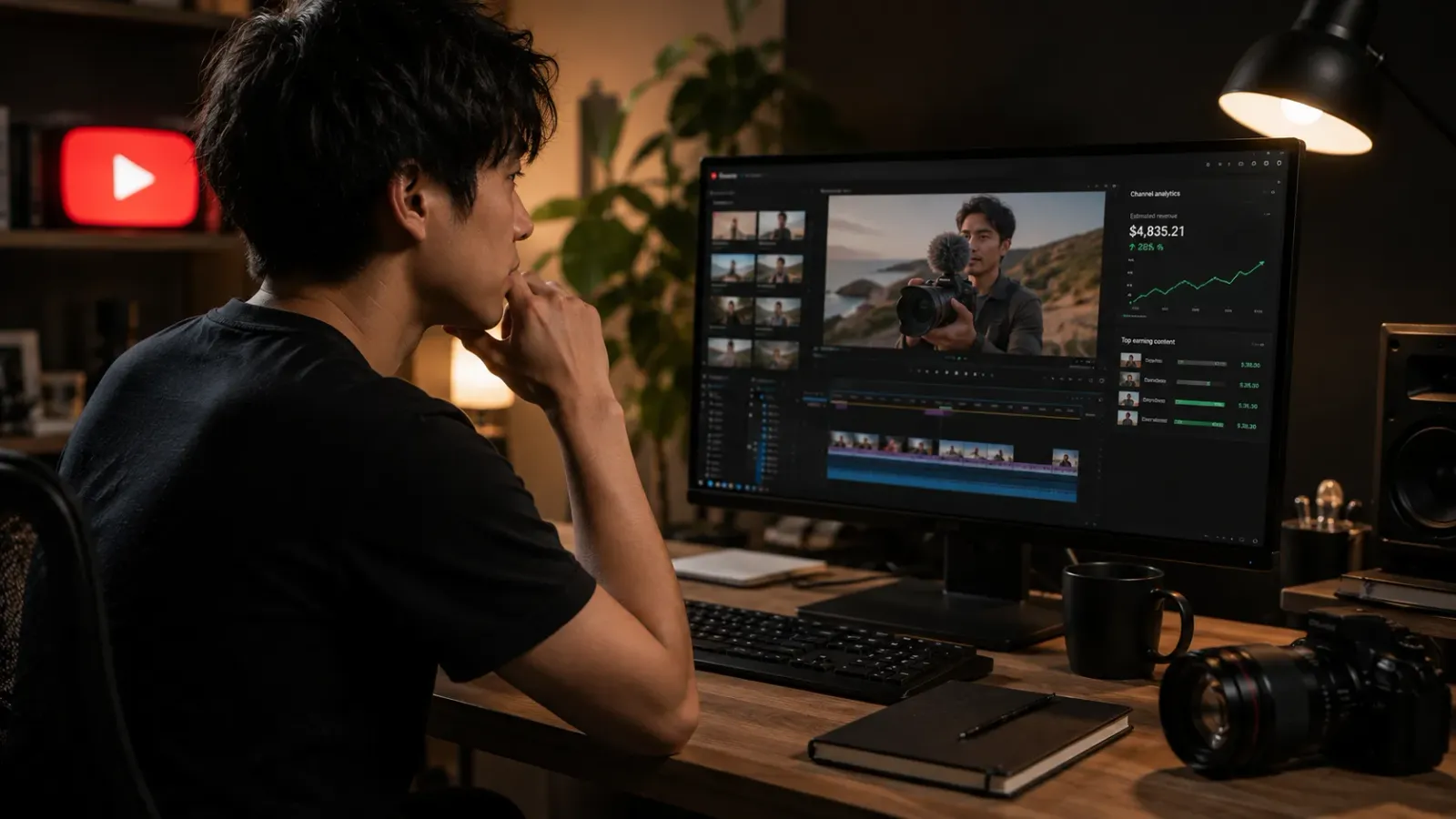
Most YouTube creators treat video editing as a production cost and RPM as something determined by niche and audience size. The relationship between the two is much more direct than that. This guide covers how specific editing decisions affect Average View Duration, mid-roll ad impressions, and the algorithmic signals that determine how often your videos get recommended.
How Does Video Editing Affect YouTube Monetization? Video editing directly affects the two metrics most tightly correlated with YouTube ad revenue: Average View Duration (AVD) and Click-Through Rate (CTR). Higher retention keeps mid-roll ads playing longer and signals to the algorithm that your content is worth recommending. Specific editing decisions, including pacing, pattern interrupts, chapter structure, and hook quality, are measurably connected to whether viewers stay through the monetization window or leave before an ad has a chance to serve.
Key Takeaways:
Retention Is the Revenue Signal: YouTube pays based on ad impressions. Ads only serve to viewers who are still watching. Every viewer who drops off before the mid-roll mark is a missed impression.
Editing Determines Drop-Off Points: The retention graph in YouTube Studio shows exactly where viewers leave. Almost every drop-off point corresponds to an editing decision: a slow segment, a long introduction, or a missed pattern interrupt.
Mid-Roll Ads Require Earned Attention: Videos over 8 minutes qualify for mid-roll ads, but those ads only generate revenue if the viewer is still watching when they serve. A 15-minute video with 25 percent retention earns less than an 8-minute video with 60 percent retention.
The Monetization Metric Most Creators Are Not Optimizing
Most YouTube monetization conversations focus on RPM fluctuations, niche selection, seasonal ad market swings, and subscriber count thresholds. These are real factors. But the editing-to-revenue connection is underrepresented in most creator education, despite being one of the most directly actionable levers a creator has.
RPM (Revenue Per Mille, or revenue per 1,000 views) is partly determined by your niche and audience demographics, which you cannot change in post-production. But CPM-weighted playback impressions, the number your channel is actually paid on, depend on how many of those views deliver a complete enough watch session to serve an ad. That number is almost entirely determined by editing quality.
Chapter 1: Average View Duration and the Retention Graph
YouTube's retention graph is the most direct feedback mechanism a creator has access to. It shows the exact percentage of viewers still watching at every second of the video, and it turns editing decisions into visible data.
The pattern is consistent across channels: sharp drops in the retention curve almost always correspond to a specific moment in the edit. A long, slow introduction. A tangential story that loses the thread of the main argument. A segment where nothing happens visually while the creator talks. A section of dead air after a cut. These are not content problems. They are editing problems, and they are fixable in post-production.
For the full breakdown of how specific editing techniques affect AVD and what the algorithm does with that data, see our guide on Algorithmic Pacing: How Editing Affects Average View Duration.
Chapter 2: The Editing Techniques That Move Retention
Pattern Interrupts
Human attention operates in cycles. Research on viewer behavior consistently shows that uninterrupted talking-head footage begins losing attention after 30 to 60 seconds regardless of content quality. A pattern interrupt, any visual or audio change that resets the viewer's attention, resets that cycle.
Pattern interrupts in YouTube editing include: cuts to b-roll footage, zooms or reframes on the same camera, graphic overlays or text cards, audio music swells, and screen recordings or diagrams. The type matters less than the frequency. The retention curves for channels with consistent pattern interrupts every 30 to 60 seconds are measurably flatter, meaning fewer viewers are leaving at any given point, than channels without them.
Hook Engineering
The highest drop-off moment in almost every YouTube video is the first 30 seconds. This is where the viewer decides whether the video is going to deliver what the thumbnail and title promised. An edit that spends the first 30 seconds on a slow intro, a generic welcome, or a pre-story setup loses a disproportionate percentage of viewers before a single mid-roll ad has a chance to serve.
The editing standard for the first 30 seconds: no cold opens that are not directly related to the video's core promise, no extended introductions, and a specific validation in the first 20 to 30 seconds that confirms the viewer made the right choice clicking. For more on engineering the hook at the edit stage, see our guide on YouTube Video Editor for Retention: Beyond Just Cuts.
Chapter Structure for Mid-Roll Revenue
For videos over 8 minutes, chapter structure determines where mid-roll ads serve and whether viewers are in high-attention or low-attention moments when those ads appear. YouTube typically serves mid-roll ads at mid-points in the video and at chapter breaks.
Structuring chapters so that high-value content (the most anticipated segment, the practical demonstration, the key result) comes after natural ad break points rather than before them means the viewer has an incentive to return to the video after an ad rather than clicking away. This is not about tricking viewers. It is about structuring the content so the ad appears at a moment when the viewer already has a reason to stay.
Chapter 3: CTR Is Also an Editing Decision
Click-Through Rate, the percentage of impressions that result in a click, is determined by the thumbnail and title. Both of these are influenced by editing decisions made during post-production.
Thumbnails that perform well on YouTube almost always feature a clear, high-contrast still frame from the video itself, often combined with a graphic element or text overlay. Choosing that still frame, selecting the moment of highest visual impact and facial expression from the recording, is an editing decision. The thumbnail cannot be designed well if the editor does not identify the right source frame from the footage.
For the full breakdown of how thumbnail strategy starts in the edit, including the frame selection criteria that consistently produce higher CTR, see our guide on YouTube Thumbnail Strategy: It Starts in the Edit.
Chapter 4: Captions and the Watch Time Signal
Burned-in captions improve retention on YouTube, particularly for videos watched on mobile with sound off in a shared environment. The mechanism is straightforward: a viewer who cannot hear the audio will leave almost immediately without captions. A captioned video gives them a reason to keep watching even in a sound-off context, which preserves the watch time signal YouTube uses to determine algorithmic promotion.
For data on the retention impact of captions across different platforms, see our research piece Captions vs. Subtitles: Engagement Impact Study.
Chapter 5: Scaling Output Without Sacrificing Retention Quality
The tension for most YouTube channels is between posting frequency (which the algorithm rewards) and editing quality (which retention rewards). Producing three videos per week with shallow editing produces worse algorithmic outcomes than producing one video per week with the editing depth that generates 55 percent retention. The math on this is not close.
The solution is not choosing between frequency and quality. It is building a production system that delivers both. For how to build that system, see our guide on How to Scale Video Production from 1 to 3 Videos a Week. And for the cross-platform distribution decisions that extend the revenue life of each piece of content beyond YouTube itself, see Shorts vs TikTok vs Reels: Editing Choices That Matter.
Frequently Asked Questions
Q: How does video editing quality affect YouTube monetization?
A: Video editing directly affects Average View Duration and Click-Through Rate, the two metrics most tightly correlated with YouTube ad revenue. Higher retention keeps ads playing longer. Better pacing reduces drop-offs at key exit points. Strong thumbnails sourced from the edit improve CTR, which determines how often YouTube recommends the video.
Q: What is a good Average View Duration on YouTube?
A: A good Average View Duration is generally 40 to 50 percent of total video length for videos over 10 minutes, and 60 percent or higher for videos under 5 minutes. Channels consistently hitting these benchmarks see stronger algorithmic promotion and higher RPM than those with lower retention.
Q: Does video length affect YouTube RPM?
A: Yes, indirectly. Videos over 8 minutes qualify for mid-roll ads, which increases ad revenue per view significantly. However, longer videos only generate more revenue if retention stays high enough to serve those mid-roll ads. A 12-minute video with 30 percent retention generates fewer mid-roll impressions than an 8-minute video with 60 percent retention.
Q: What editing techniques improve YouTube retention?
A: Pattern interrupts every 30 to 60 seconds, strong chapter structure with value front-loaded in each segment, removal of dead air and filler content, and a hook that validates the viewer's decision within the first 30 seconds all contribute to measurably higher retention.
Your retention rate is your revenue rate. Editing Machine's dedicated team applies retention-optimized editing to every video: pattern interrupts, tight pacing, chapter structure, and hook engineering built in as standard. Start your first project.
More from the Blog

Video Content Repurposing: The 10x Multiplier Framework
Most content creators treat repurposing as something they do when they have time, which means they almost never do it. The 10x Multiplier Framework treats it as the default production model: every recording session is planned with repurposing built in from the start, and every edited asset points toward the next format. This guide covers the full framework and the specific formats each recording type should produce.
Shopify Product Video: The Editing Checklist That Lowers Bounce Rate
Adding a video to your Shopify product page is not the same as adding a video that lowers bounce rate and increases conversion. Most product videos on Shopify are too long, start too slowly, and are not optimized for silent autoplay on mobile. This editing checklist covers every decision that separates a product video that converts from one that gets scrolled past.

Dedicated Video Editor Service: When a Subscription Beats a Full-Time Hire
Most businesses that are considering hiring a full-time video editor have not run the real numbers. When you include benefits, equipment, software licenses, desk space, and management overhead, a full-time junior editor in the US costs $65,000 to $80,000 per year in total. This guide runs the full cost comparison and identifies the output threshold at which a subscription service wins on economics.
See if Editing Machine is the right fit for your content.
Take 90 seconds to tell us about your goals, content style, and volume. We'll show you which setup fits and exactly where to start.